Nursery & sleep guide
From Crib to Big-Kid Bed: What to Compare in a Child’s Sleep Setup
A child’s first larger bed is more than a change in scale. It is a small domestic redesign, shaped by a growing body, a new room routine and the practical realities of family life. Compare fit, support, materials and care before choosing—and let safety, not aesthetics alone, guide the final decision.
The move from crib to big-kid bed tends to arrive with a flurry of decisions: whether to keep the familiar room or rearrange it, which size mattress will suit the space, and how to make a new sleep surface feel reassuring rather than unfamiliar. It is tempting to treat the transition as a shopping milestone. In reality, it is a chance to take stock of what a child needs now—and what the family can comfortably maintain over the next few years.
There is no single timetable that fits every child. A transition may be prompted by a child climbing out of the crib, outgrowing its limits, or simply being ready for a different arrangement. Follow the crib manufacturer’s height and weight limits, and discuss individual safety questions with a pediatric clinician. The goal is not to make the room look older overnight. It is to build a sleep setup that suits the child’s stage, the room’s dimensions and the household’s care routines.
Begin with the room, not the mattress label
Before comparing materials or firmness descriptions, measure the room. Note the available floor area, door swing, closet access, heating vents and the location of windows. A bed that looks elegantly proportioned in a product listing may feel imposing once it is placed between a dresser and a doorway. Leave enough clear space for a child to move around the bed and for an adult to help with sheets, bedtime reading and nighttime reassurance.
Then check the bed frame and mattress dimensions as a pair. Do not rely on a name such as “twin” or “full” alone: confirm the exact measurements and make sure the mattress is designed to fit the frame without large gaps. A stable, compatible foundation matters for comfort and for the way a mattress performs. If the family is reusing a frame, inspect it for loose hardware, broken slats and sharp edges before making it part of the new setup.
Room planning should include the furniture around the bed, too. Dressers and shelves need to be secured according to their manufacturers’ instructions, and cords, lamps and small objects should be arranged with a newly mobile child in mind. The transition often gives a child more freedom to get in and out of bed, so the room deserves the same thoughtful safety review as the mattress itself.
Compare support and feel with care
A mattress should provide an even, supportive surface that fits its intended frame. Yet comfort is personal, and labels such as “soft,” “medium” or “firm” are not perfectly standardized across manufacturers. Instead of assuming a child will prefer the same feel as an adult, read the construction details, review the stated comfort level and consider any available in-person testing or return terms.
A child’s sleep surface does not need to be selected by chasing the plushest top or the most elaborate construction. Excessive softness, deep quilting and add-on toppers can change how a mattress feels and may complicate fit. For infants, safe-sleep recommendations are especially specific: use a firm, flat sleep surface designed for infant sleep, covered only with a fitted sheet, and follow current guidance from trusted pediatric and public-health authorities. Do not add pillows, loose bedding, positioners or toppers to an infant’s sleep space.
For a child who has outgrown the crib and is moving to a larger bed, the appropriate setup depends on age, development and the bed’s design. Read the bed and mattress instructions, including any guidance about rails or other accessories. A rail should be compatible with the bed and used as directed; it is not a substitute for checking mattress fit or keeping the surrounding area safe.
A crib mattress is a distinct category
Crib mattresses are made to fit particular crib dimensions and meet requirements for infant sleep products. They are not simply smaller versions of adult mattresses. A crib mattress should fit the crib frame as specified by its manufacturer, and caregivers should follow the crib and mattress manuals rather than improvising with extra padding or altered components.
Some designs offer two stages, with a firmer infant side and a different surface intended for toddler use. The existence of two sides does not make every crib mattress suitable for every later bed, nor does it override the product’s age, use or safety instructions. If a mattress is being reused, check its condition, history, dimensions and manufacturer guidance. A surface that is damaged, damp, sagging or no longer a proper fit should not be kept in service simply because it once worked in the nursery.
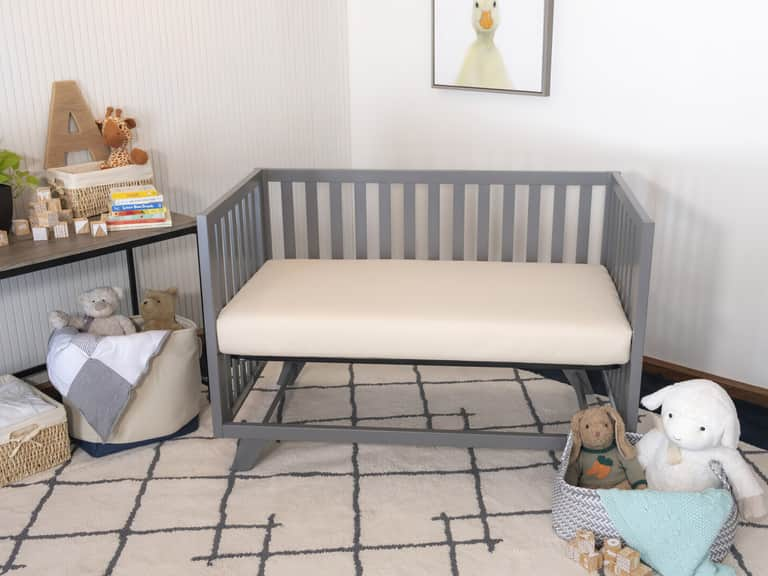
One example in the Nursery category is the Naturepedic Breathable 2-Stage Organic Crib Mattress. Its listed design includes a firm infant side, a toddler side and a removable, washable pad. It is sized for standard cribs at approximately 27¼ by 51⅝ inches and six inches thick. Families should verify current product details and follow the manufacturer’s instructions, including guidance on which side is appropriate for a child’s stage. It is a crib mattress—not a general-purpose big-kid-bed mattress.
What “organic” can—and cannot—tell you
Organic is a useful starting point for asking questions about materials, but it is not a complete description of a mattress. A product may contain several layers, covers and treatments, each with a different composition. Look for a clear breakdown of the finished product: what is in the core, what forms the comfort layers, what covers the mattress and how those components are joined or finished.
Certifications can help clarify particular claims, but they are not interchangeable. GOTS is associated with organic textiles and their processing requirements; GOLS is a standard associated with organic latex. A certification for one component does not automatically mean every material in the whole mattress is certified organic. Check the product’s documentation and the scope of the certification rather than relying on a badge or a broad phrase on a product page.
It is also worth distinguishing material origin from health or safety performance. “Natural,” “organic,” “low-emission” and “chemical-free” are not synonyms, and no single label answers every question. Ask what the claim applies to, whether a named standard has been used and whether documentation is available. Transparent descriptions are more useful than sweeping promises.
Materials, layer by layer
Latex, cotton, wool, foam and spring systems each behave differently. Latex is resilient and responsive, while cotton commonly appears in covers or padding. Wool may be used in upholstery and can contribute to moisture management; its role and certification should be confirmed in the product details. Some mattresses use coils or other structural systems, while others rely on layered materials. Construction affects weight, feel, airflow, edge behavior and the way a bed is handled during care.
A material name alone does not establish quality or suitability. “Latex,” for instance, does not tell a shopper whether the material is certified organic, what process was used, or where it appears in the mattress. Likewise, “cotton cover” does not establish that the cover is organic or that the full mattress meets an organic standard. Compare complete specifications rather than treating a familiar fiber as a shortcut to a verdict.
For families who are considering a larger latex mattress, the Naturally Organic Hudson Latex Mattress is listed as an eight-inch mattress with a five-inch firm organic Dunlop latex support layer and a three-inch medium organic Dunlop latex layer. Its description also identifies GOTS-certified organic cotton and wool, and lists a 20-year limited warranty. The available product information describes adult mattress dimensions, so shoppers should confirm that the chosen size and setup are appropriate for their child and bed frame. A product’s organic materials or warranty do not replace a check of fit, comfort and care requirements.
Protection and care: the details that make a bed livable
Children’s beds encounter spills, sweat, skin oils and the occasional nighttime accident. A washable, well-fitting protective layer can make routine care easier, but the right choice depends on the mattress maker’s instructions and the child’s needs. Check whether a protector is waterproof or simply absorbent, how it attaches, whether it can be laundered at home, and what temperatures or detergents the care label permits.
A protector should fit without bunching or pulling at the corners. For a crib, use only products specifically compatible with the mattress and crib, and follow all current safe-sleep guidance. Do not add a separate pad or protector if the product instructions or pediatric safety guidance advise against it. In a larger bed, a fitted protector can help shield the mattress, but it should not alter the bed’s fit or create a loose, unstable layer.
Care instructions are part of the purchase, not an afterthought. Some covers are removable; others are spot-clean only. Some wool or latex components require careful handling and should not be washed. Read the warranty alongside the cleaning guidance: bleach, high-heat drying or unapproved disassembly may void coverage or damage materials. A mattress that is easy to care for in theory but difficult to clean in the family’s actual routine may not be the most practical choice.
The right size is a room-by-room decision
A twin bed often suits a smaller room, while a larger size may offer more room to grow if the floor plan and budget allow. Consider how long the family expects to use the bed, whether it will need to accommodate an adult sitting beside a child, and whether moving it through stairs and doorways will be straightforward. A larger mattress can be a sensible long-term choice, but not if it leaves too little room for safe movement or everyday use.
Measure access routes as carefully as the bedroom. Hallways, stair turns and door frames can make delivery or future replacement complicated. Confirm the bed’s overall dimensions, not only the mattress size, and account for a headboard, rails or foundation. If a mattress is unusually heavy, ask how it can be rotated or moved during cleaning; some constructions are easier to manage than others.
Sleep setup is more than the sleep surface
Once the mattress and frame are chosen, keep the rest of the bed simple and compatible. Sheets should fit the mattress depth without slipping free. The pillow question depends on the child’s age and development; do not add pillows or loose bedding to an infant’s sleep space. For older children, choose bedding that can be laundered easily and that does not bunch or trail in a way that creates a tripping hazard.
Temperature comfort is influenced by more than fiber labels. Room temperature, sleepwear, blankets, mattress construction and the child’s own preferences all play a role. Breathable materials can be one factor in a comfortable bed, but product claims are not guarantees that a child will sleep cool. Observe how the child seems to sleep and adjust layers conservatively, following age-appropriate safety guidance.
A calm transition, rather than a dramatic reveal
The most beautiful room is one that works after the novelty wears off. Familiar bedtime routines can help make a new bed feel less like a sudden change: keep the usual story, song or wind-down sequence, and introduce the new setup at a pace that suits the child. Let them become familiar with the bed during calm daytime moments, while keeping the room arranged for safety when they begin moving independently at night.
Avoid turning the purchase into a promise that a child will sleep through the night or settle immediately. A new mattress cannot guarantee sleep outcomes, and changing beds can take time. If a child has persistent sleep difficulties or there are concerns about development, breathing or comfort, consult an appropriate healthcare professional rather than relying on product features as a remedy.
A practical comparison checklist
Before making a decision, compare shortlisted options against the same questions. A consistent checklist helps separate the details that matter from polished language and attractive packaging.
- Fit: Do the mattress dimensions match the bed or crib manufacturer’s specifications?
- Stage: Is the product intended for an infant crib, a toddler setup or a larger bed, and what do its instructions say?
- Support: What is the stated feel and construction, and can the child try it or return it if it is unsuitable?
- Materials: Are the core, comfort layers and cover clearly described?
- Certification: Which specific materials or processes are covered, and can the claim be documented?
- Care: Is the cover removable, what cleaning methods are allowed, and is a compatible protector available?
- Durability: What does the warranty cover, and what exclusions apply?
- Practicality: Can the mattress be delivered, moved and maintained within the family’s space and routine?
- Total cost: Include the frame, foundation, protector, delivery and any disposal or return fees.
A thoughtful choice is a well-documented one
From crib to big-kid bed, the best comparison is not a contest to find the most luxurious description. It is an exercise in matching a child’s stage and sleep surface to a well-measured room, a compatible frame, materials the family understands and care instructions it can follow. Organic certifications may offer useful clarity when their scope is specific, but they should sit alongside the fundamentals: fit, support, safety and maintenance.
Take time to read product documentation, verify dimensions and ask manufacturers direct questions when a claim is unclear. A carefully chosen bed can make the next phase feel considered rather than hurried—a quiet, practical foundation for the evolving rhythms of childhood.